Find your strength context
Read the result as a work priority rather than an ability grade. Compare whether you tend to lead with pace, participation, stability, or accuracy in real situations.
MindCheck free test
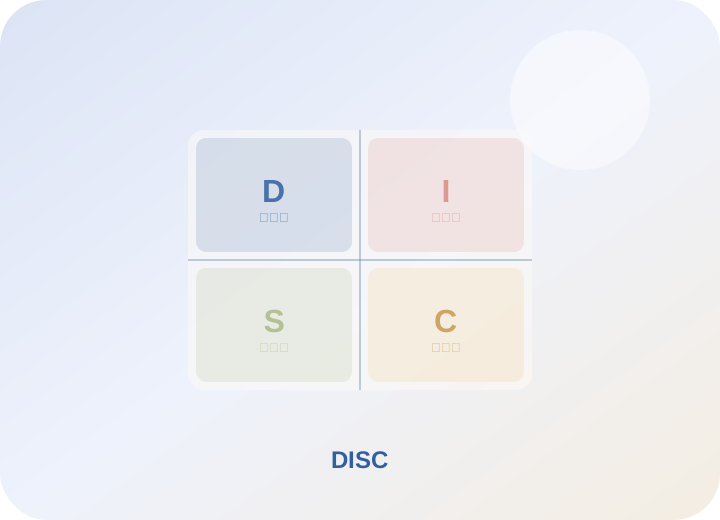
Identify your D, I, S, or C behavior pattern through 20 questions about work and relationships.
Identify your D, I, S, or C behavior pattern through 20 questions about work and relationships.
20
5
4
Team leaders, professionals, and job seekers
Your answers and results are calculated in this browser and are not stored on MindCheck servers.
MindCheck results are self-reflection content only. They do not replace medical diagnosis, therapy, or professional assessment.
Original MindCheck items are summed by dimension to show the strongest pattern in your current answers. This is not a certified clinical assessment. How scoring works
Checking your saved progress
Guide
Look at when your pattern becomes a strength and when it creates friction in work and relationships.
Read the result as a work priority rather than an ability grade. Compare whether you tend to lead with pace, participation, stability, or accuracy in real situations.
The type opposite to yours can feel frustrating. Try seeing it as complementary: D and S balance speed with steadiness, I and C balance enthusiasm with accuracy.
Under pressure, a usual strength may be overused: drive can become unilateral, connection can avoid the core issue, steadiness can delay change, and accuracy can turn into endless review.
Evidence-aware reading
One distinction matters
Useful as a prompt for reflection and conversation, not as a scientifically settled personality classification.
DISC is widely used as workplace language for observable tendencies around dominance, influence, steadiness, and conscientiousness. Different products use different items, scoring, and norms, so the name alone cannot guarantee reliability or validity.
Use it to discuss whether you prioritize pace, relationships, stability, or accuracy and what you may need to adjust when collaborating with a different style.
MindCheck DISC is not a certified version of any commercial DISC product. Do not use it for hiring, promotion, or aptitude decisions, and expect behavior to change by situation.
FAQ
Common questions about the DISC Personality Test and what the result means.
DISC looks at observable behaviour rather than good or bad personality. Dominance (D) prioritises results and speed, Influence (I) moves work through people and energy, Steadiness (S) values consistency and preserving relationships, and Conscientiousness (C) checks accuracy and standards first. The same person can behave differently in a meeting than at home, so this test asks which mode feels most natural to you.
No. Most people carry all four and score higher on one or two. Your highest type is closest to your default setting, while the second-highest often shows up under pressure or in a familiar team. If your scores are close together, you likely switch styles fluidly depending on the situation.
The Big Five is a research-validated model of personality traits, while DISC is closer to a practical language for workplace communication and teamwork. DISC's strength is immediate usefulness — how to phrase something to this colleague in this meeting. Its weakness is that four categories are too simple to describe a whole personality. For depth of self-understanding, use the Big Five; for smoother team communication, DISC is more actionable.
They should not be. A short self-report online test does not have the reliability required for decisions that affect someone's opportunities, such as hiring, promotion, or evaluation. DISC is most useful as a starting point for a conversation, helping teammates understand each other's styles and reduce friction.
Match what the other person wants to hear first. Lead with the conclusion and impact for a D, with the vision and who is involved for an I, with the pace of change and what it means for them for an S, and with evidence and data for a C. The content can stay the same — simply changing the order dramatically reduces resistance.
Try next
Take a related test next to understand your pattern from another angle.